The UAE VAT landscape continues to evolve, making it increasingly important for businesses to maintain accurate tax calculations and reliable financial records.
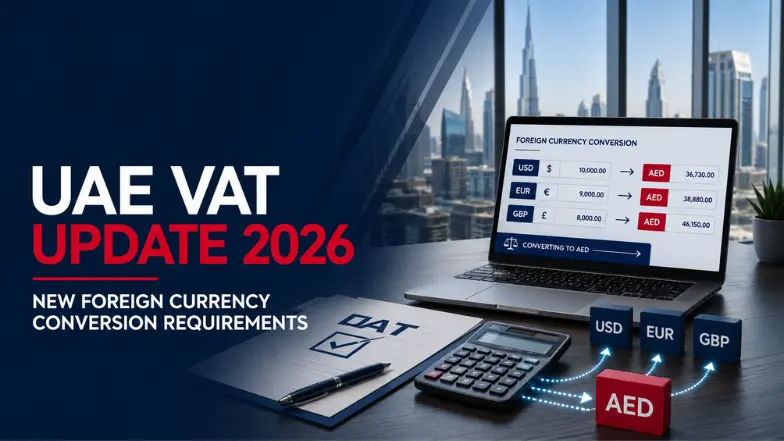
One area requiring particular attention in 2026 is the treatment of transactions conducted in foreign currencies. The Federal Tax Authority (FTA) has provided updated guidance concerning the conversion of foreign currency amounts into UAE dirhams for VAT purposes.
For UAE businesses dealing with international customers, overseas suppliers, or transactions denominated in currencies other than AED, understanding these requirements is essential for accurate VAT reporting and compliance.
Why Foreign Currency Conversion Matters for UAE VAT
Businesses operating in the UAE frequently issue or receive invoices in currencies such as US dollars, euros, British pounds, and other foreign currencies.
However, for UAE VAT purposes, relevant amounts must be expressed in UAE dirhams (AED).
The exchange rate used can therefore directly affect the AED value recorded for a transaction and, consequently, the VAT amount reported.
Even relatively small inconsistencies in exchange-rate calculations can become significant when a business processes a large number of foreign currency transactions.
For finance and accounting teams, the issue is not simply choosing an exchange rate. Businesses also need a consistent and properly documented approach that can be supported by their accounting records.
What Has Changed in 2026?
The 2026 update provides businesses with a clearer framework for determining the appropriate AED equivalent when dealing with foreign currency transactions for VAT purposes.
A key aspect is the use of approved exchange-rate platforms when determining the applicable conversion rate.
Where the relevant requirements apply, businesses should use the prescribed approach to determine the AED value at the appropriate time and date of the transaction.
This is particularly important for companies with regular cross-border transactions or accounting systems that automatically convert foreign currency amounts.
Consistency Is Important
One of the important compliance considerations under the updated approach is consistency.
Once a business adopts the relevant approved platforms for determining its foreign currency exchange rates, the same selected platforms should be used consistently throughout the applicable calendar year.
This means finance teams should avoid changing exchange-rate sources simply because another platform provides a more favourable rate for a particular transaction.
A documented and consistent methodology can help businesses maintain reliable VAT calculations and provide a clearer audit trail.
How Should the Exchange Rate Be Determined?
For transactions requiring foreign currency conversion, businesses should determine the appropriate exchange rate based on the applicable requirements at the relevant date and time of the supply or receipt.
Where the methodology requires rates from the approved platforms, the relevant rates should be obtained and the required average calculated to establish the AED equivalent.
Businesses should ensure that the process used in practice matches the methodology configured within their accounting or ERP system.
This is particularly important for companies processing high volumes of transactions automatically.
Which Businesses Should Pay Attention?
The update can be particularly relevant for UAE businesses that regularly deal with:
- International customers and suppliers
- Foreign currency tax invoices
- Cross-border services
- Imports and exports
- Overseas professional service providers
- International e-commerce transactions
- Multi-currency accounting systems
Businesses with only occasional foreign currency transactions should also ensure that the correct methodology is followed whenever such transactions occur.
Impact on Accounting and Bookkeeping
This VAT update is not only a tax department matter. It also has practical implications for accounting and bookkeeping processes.
Accounting teams may need to review how exchange rates are captured in their systems, how foreign currency invoices are converted, and whether supporting evidence for the rates used is being maintained.
Businesses should consider reviewing:
Accounting software settings: Confirm that exchange-rate configurations align with the VAT requirements.
Tax invoice processing: Ensure foreign currency invoices are converted appropriately for VAT reporting.
Record keeping: Maintain sufficient documentation supporting the exchange rates and methodology applied.
Internal procedures: Establish a consistent process that accounting and VAT teams can follow.
System automation: Check whether ERP or accounting software automatically retrieves rates from sources that align with the business’s selected methodology.
A mismatch between the company’s VAT procedure and its accounting system could potentially result in inconsistent reporting.
Why Record Keeping Is Essential
Accurate documentation is an important part of VAT compliance.
Businesses should be able to demonstrate how the AED value of a foreign currency transaction was determined. This may include maintaining appropriate evidence of the exchange rates used and ensuring that transaction records can be reconciled with VAT returns and accounting records.
Strong record-keeping procedures also make it easier to respond if transaction calculations are reviewed as part of a tax audit or compliance check.
What Should UAE Businesses Do Now?
Businesses dealing with foreign currency transactions should use this update as an opportunity to review their existing VAT and accounting procedures.
Finance teams should identify the exchange-rate sources currently being used, confirm whether their methodology meets the applicable requirements, and check whether the same approach is being followed consistently.
Companies should also review their accounting software and ERP configurations rather than assuming that automatically generated exchange rates are suitable for UAE VAT purposes.
Where there is uncertainty, obtaining professional VAT advice can help identify potential gaps before they affect future VAT returns.
Need assistance reviewing your UAE VAT compliance?
Talk to our tax experts at Alliance Prime.
Disclaimer: This article is for general informational purposes only and does not constitute tax, legal, or professional advice. UAE tax regulations and guidance may be updated or amended from time to time. Businesses should assess the requirements based on their specific circumstances and seek professional advice where necessary