Tag: corporate tax
UAE VAT Update 2026: New Foreign Currency Conversion Requirements Businesses Need to Know
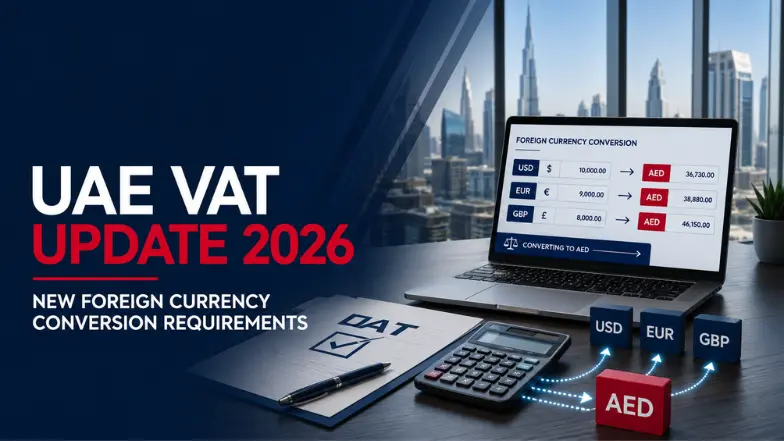
The UAE VAT landscape continues to evolve, making it increasingly important for businesses to maintain accurate tax calculations and reliable financial records.
One area requiring particular attention in 2026 is the treatment of transactions conducted in foreign currencies. The Federal Tax Authority (FTA) has provided updated guidance concerning the conversion of foreign currency amounts into UAE dirhams for VAT purposes.
For UAE businesses dealing with international customers, overseas suppliers, or transactions denominated in currencies other than AED, understanding these requirements is essential for accurate VAT reporting and compliance.
Why Foreign Currency Conversion Matters for UAE VAT
Businesses operating in the UAE frequently issue or receive invoices in currencies such as US dollars, euros, British pounds, and other foreign currencies.
However, for UAE VAT purposes, relevant amounts must be expressed in UAE dirhams (AED).
The exchange rate used can therefore directly affect the AED value recorded for a transaction and, consequently, the VAT amount reported.
Even relatively small inconsistencies in exchange-rate calculations can become significant when a business processes a large number of foreign currency transactions.
For finance and accounting teams, the issue is not simply choosing an exchange rate. Businesses also need a consistent and properly documented approach that can be supported by their accounting records.
What Has Changed in 2026?
The 2026 update provides businesses with a clearer framework for determining the appropriate AED equivalent when dealing with foreign currency transactions for VAT purposes.
A key aspect is the use of approved exchange-rate platforms when determining the applicable conversion rate.
Where the relevant requirements apply, businesses should use the prescribed approach to determine the AED value at the appropriate time and date of the transaction.
This is particularly important for companies with regular cross-border transactions or accounting systems that automatically convert foreign currency amounts.
Consistency Is Important
One of the important compliance considerations under the updated approach is consistency.
Once a business adopts the relevant approved platforms for determining its foreign currency exchange rates, the same selected platforms should be used consistently throughout the applicable calendar year.
This means finance teams should avoid changing exchange-rate sources simply because another platform provides a more favourable rate for a particular transaction.
A documented and consistent methodology can help businesses maintain reliable VAT calculations and provide a clearer audit trail.
How Should the Exchange Rate Be Determined?
For transactions requiring foreign currency conversion, businesses should determine the appropriate exchange rate based on the applicable requirements at the relevant date and time of the supply or receipt.
Where the methodology requires rates from the approved platforms, the relevant rates should be obtained and the required average calculated to establish the AED equivalent.
Businesses should ensure that the process used in practice matches the methodology configured within their accounting or ERP system.
This is particularly important for companies processing high volumes of transactions automatically.
Which Businesses Should Pay Attention?
The update can be particularly relevant for UAE businesses that regularly deal with:
- International customers and suppliers
- Foreign currency tax invoices
- Cross-border services
- Imports and exports
- Overseas professional service providers
- International e-commerce transactions
- Multi-currency accounting systems
Businesses with only occasional foreign currency transactions should also ensure that the correct methodology is followed whenever such transactions occur.
Impact on Accounting and Bookkeeping
This VAT update is not only a tax department matter. It also has practical implications for accounting and bookkeeping processes.
Accounting teams may need to review how exchange rates are captured in their systems, how foreign currency invoices are converted, and whether supporting evidence for the rates used is being maintained.
Businesses should consider reviewing:
Accounting software settings: Confirm that exchange-rate configurations align with the VAT requirements.
Tax invoice processing: Ensure foreign currency invoices are converted appropriately for VAT reporting.
Record keeping: Maintain sufficient documentation supporting the exchange rates and methodology applied.
Internal procedures: Establish a consistent process that accounting and VAT teams can follow.
System automation: Check whether ERP or accounting software automatically retrieves rates from sources that align with the business’s selected methodology.
A mismatch between the company’s VAT procedure and its accounting system could potentially result in inconsistent reporting.
Why Record Keeping Is Essential
Accurate documentation is an important part of VAT compliance.
Businesses should be able to demonstrate how the AED value of a foreign currency transaction was determined. This may include maintaining appropriate evidence of the exchange rates used and ensuring that transaction records can be reconciled with VAT returns and accounting records.
Strong record-keeping procedures also make it easier to respond if transaction calculations are reviewed as part of a tax audit or compliance check.
What Should UAE Businesses Do Now?
Businesses dealing with foreign currency transactions should use this update as an opportunity to review their existing VAT and accounting procedures.
Finance teams should identify the exchange-rate sources currently being used, confirm whether their methodology meets the applicable requirements, and check whether the same approach is being followed consistently.
Companies should also review their accounting software and ERP configurations rather than assuming that automatically generated exchange rates are suitable for UAE VAT purposes.
Where there is uncertainty, obtaining professional VAT advice can help identify potential gaps before they affect future VAT returns.
Need assistance reviewing your UAE VAT compliance?
Talk to our tax experts at Alliance Prime.
Disclaimer: This article is for general informational purposes only and does not constitute tax, legal, or professional advice. UAE tax regulations and guidance may be updated or amended from time to time. Businesses should assess the requirements based on their specific circumstances and seek professional advice where necessary
Corporate Tax Planning Strategies for Dubai Businesses

Corporate tax in the UAE has changed how companies handle their finances. Businesses in Dubai focus on profit growth and also on following tax laws closely. Every company needs a clear corporate tax strategy in Dubai. This ensures stability, transparency, and lasting success.
At Alliance Prime Accounting & Tax Consultancy, we are an approved FTA tax agent. We help businesses plan their taxes effectively. This way, they can stay ahead of regulatory changes. With expert help and solid financial planning, companies can save on taxes in the UAE. This also helps them build a sustainable future.
Why Corporate Tax Planning Matters
Corporate tax planning helps businesses save money, manage profits, and follow FTA rules. Many companies put off tax planning until year-end. This can cause missed deductions or penalties. A strong corporate tax strategy in Dubai improves this. It relies on smart financial management throughout the year.
When businesses grasp their tax duties early, they can:
- Organize documents
- Spot eligible deductions
- Shape operations for tax efficiency in the UAE.
This boosts compliance and cash flow. Companies gain more room to invest and grow.
Key Principles of a Corporate Tax Strategy Dubai
An effective tax strategy requires organization, clarity, and consistent review. Below are key principles that help businesses manage corporate tax efficiently in Dubai.
1. Keep Transparent Financial Records
Every business should maintain clear and detailed records of income and expenses. Well-organized data helps during audits and simplifies the calculation of taxable income. It also builds the foundation of a reliable corporate tax strategy Dubai.
2. Identify Allowable Deductions
Businesses can lower their taxes by claiming valid deductions. These include rent, employee salaries, utilities, and marketing costs. Tracking these costs correctly enhances tax efficiency UAE and prevents errors during filing.
3. Review Your Business Structure
Some company setups offer better tax benefits than others. Reviewing your legal structure can help you save on taxes and stay compliant. For example, some free-zone entities have special conditions that can affect taxation.
4. Build a Compliance Calendar
Missing deadlines can lead to penalties. Setting reminders for filing dates and review sessions keeps your team consistent. Timely filing also improves your company’s professional reputation with the FTA.
5. Seek Expert Guidance
Working with qualified professionals saves time and minimizes risk. Alliance Prime Accounting & Tax Consultancy is an approved tax agent by the FTA. We provide clear advice and craft a custom corporate tax strategy in Dubai. It fits your business model perfectly.
How to Improve Tax Efficiency UAE
To achieve tax efficiency in the UAE, manage your business to lower liability legally. The process involves three important steps:
1. Smart Investment Decisions
Businesses should analyze which investments qualify for deductions or tax benefits. Putting money into capital for a business can cut taxable income and enhance financial results.
2. Monitor Business Expenses
Consistent tracking of expenses throughout the year ensures that no deduction is missed. Digital tools and accounting systems make this easier by keeping accurate financial records.
3. Regular Financial Reviews
Check in every quarter or twice a year. This way, you can spot tax-saving options before the fiscal year ends. It also ensures that your financial data remains organized and ready for filing.
These simple actions boost tax efficiency in the UAE. They also help your company grow responsibly.
Common Tax Planning Mistakes to Avoid
Even well-managed businesses can make errors that increase tax liability. Some common mistakes include:
- Mixing business and personal expenses
- Ignoring early tax planning
- Missing filing deadlines
- Misunderstanding deductions and exemptions
- Relying on incomplete financial data
Avoiding these mistakes boosts your corporate tax strategy in Dubai. It also helps keep your credibility with authorities. Businesses that plan regularly face fewer compliance challenges and enjoy smoother audits.
The Role of Professional Tax Consultants
Corporate tax laws continue to evolve, and staying updated is essential. Experts can help your business meet FTA standards. They also keep you tax-efficient in the UAE.
At Alliance Prime Accounting & Tax Consultancy, we are an approved tax agent by FTA. Our team provides expert advice on every aspect of the tax process. We help you:
- Register correctly with the FTA
- Prepare and file accurate tax returns
- Identify allowable deductions and exemptions
- Develop cost-effective financial plans
- Avoid penalties through proactive compliance
Our goal is to turn tax obligations into opportunities. A solid plan and expert help can keep your company stable and profitable in Dubai’s tough market.
Practical Steps for Better Corporate Tax Planning
To design an effective and sustainable tax plan, follow these practical steps:
- Start Early: Plan your taxes before the financial year ends. Early preparation gives more flexibility in decision-making.
- Use Technology: Adopt accounting software that tracks income and expenses automatically.
- Schedule Reviews: Evaluate your tax strategy every quarter for accuracy and improvement.
- Train Your Staff: Make sure your finance team knows the latest tax laws and filing rules.
- Consult Professionals: Talk to experts regularly. This keeps your corporate tax strategy in Dubai up-to-date with FTA guidelines.
Follow these steps regularly. Your company will become more compliant and improve tax efficiency UAE over time.
Why Choose Alliance Prime Accounting & Tax Consultancy
Alliance Prime Accounting & Tax Consultancy is an approved tax agent by the FTA. We help businesses in Dubai and the UAE handle their corporate tax duties with ease. Our services include:
- Corporate tax registration and filing
- Ongoing tax planning and strategy development
- Financial audits and documentation reviews
- Industry-specific compliance support
- Personalized consultation for long-term growth
Our experienced consultants understand the local market and legal framework. We create simple, effective solutions that match your business goals. We also ensure full compliance with FTA requirements.
Conclusion
Tax planning is key for every successful business in Dubai. Planning ahead, keeping good records, and having a strong strategy help companies stay compliant and save on taxes in the UAE. A solid corporate tax plan in Dubai reduces financial risks and boosts growth.
At Alliance Prime Accounting & Tax Consultancy, we’re an FTA-approved tax agent. We assist businesses in crafting structured plans that increase efficiency, accuracy, and profitability. From planning to filing, our team ensures every step supports your long-term goals.
To boost your finances and simplify compliance, reach out to Alliance Prime today. Let our experts create a custom tax plan. This will keep your business compliant and confident, preparing you for the future.
UAE Corporate Tax Registration Mandatory for Medium and Small Enterprises, Even with Losses

As the UAE embarks on its first full-year corporate tax period, a crucial revelation demands the immediate attention of medium and small business owners. Contrary to some misconceptions, the latest news mandates the corporate tax registration, a requirement applicable to both profit-making and loss-incurred enterprises.
Corporate Tax in UAE is a direct tax imposed on the net income or profit of corporations and businesses introduced by the UAE Ministry of Finance. This tax reform is designed to support medium and small enterprises by instituting an initial statutory tax rate of 9% on corporate profits exceeding AED 375,000. It is obligatory to comply with the corporate tax regulations for all eligible Taxable Persons in the UAE. This involves corporate tax registration, filing annual tax returns, and maintaining accurate accounting records.
Moreover, the introduction of corporate tax in UAE is to meet the international tax standards.
Corporate Tax Registration: A Non-Negotiable Step in 2024
The Federal Tax Authority has left no room for ambiguity – all businesses operating in the UAE are obligated to register for corporate tax in 2024. This directive extends to enterprises, irrespective of their profitability or the duration of their establishment. Even businesses incurring losses are not exempt from this mandatory registration.
Despite lingering doubts among some SME owners about the urgency of corporate tax registration, experts emphasize its immediate necessity. Waiting until profits approach the Dh375,000 profit mark is a misconception that could lead to non-compliance.
Small Business Relief: A Lifeline for Eligible Entities
To address concerns, the authorities have introduced the ‘Small Business Relief’ option. Eligible taxable persons, especially those with revenues below or equal to Dh3 million, can elect for this relief on their tax return. However, even if a business qualifies for relief, the fundamental requirement remains unchanged – registration for corporate tax is mandatory.
Key Points about Small Business Relief
- Eligibility is determined by business revenue below or equal to Dh3 million for the latest and all previous tax periods.
- Once revenue exceeds Dh3 million, the business is ineligible for the relief package, even if subsequent revenues fall below the threshold.
- Despite relief, businesses must register for corporate tax, emphasizing the mandatory nature of registration for all.
Essential Considerations for Corporate Tax Compliance
As the registration process opened in June last year, businesses following the calendar year as their financial year will be paying their 2024 corporate tax by September 2025. It’s crucial for businesses to prove eligibility by submitting tax returns and maintaining necessary records.
The application of UAE Corporate Tax extends to all businesses “incorporated, effectively managed and controlled” in the UAE. Regardless of profit or revenue, registration is a non-negotiable step.
Comparing VAT and Corporate Tax
Drawing a comparison with VAT requirements, the threshold for corporate tax registration is mandatory, aligning with the ethos of a proactive approach. Even new businesses setting up in the UAE are advised to register for corporate tax immediately.
In conclusion, navigating the corporate tax landscape is essential for businesses in the UAE. The Alliance Prime team recommends the use of accounting software as part of best practices.
Stay informed, stay compliant. Act now to register for corporate tax and ensure the smooth operation of your business in accordance with the latest regulations.
Why is Alliance Prime the best Tax Consultancy in Dubai?
Alliance Prime is a leading provider of auditing, accounting, taxation, and advisory services in the UAE. Our expert team will guide you through the complex laws and regulations of UAE, including Corporate Tax, VAT, Excise Tax, Accounting and Bookkeeping, ESR, Financial Advisory, ERP, etc. We stay up-to-date with the latest changes in laws and regulations in the UAE. If you’re looking for reliable and professional auditing, accounting, taxation, and advisory services in the UAE, look no further than Alliance Prime.
Contact Alliance Prime on +971 58 825 7795 or Email us at:- contact@alliance-acc.com for expert assistance in Corporate Tax Registration.
Who is exempt from UAE corporate tax?

A person who is exempt under the UAE Corporate Tax Law is not liable to pay Corporate Tax. This can be because of automatic exemption or by exemption through an application by the Taxable Person. Further, the provision details who can automatically be considered as Exempt Persons. Also, who can apply for securing an exemption under the UAE Corporate Tax Law.
What is UAE Corporate Tax?
Corporate Tax is a direct tax applied to a corporation’s or other entity’s net income or profit from its operations. In some countries, corporate Tax is known as “Corporate Income Tax ” or “Business Tax.”
A new federal corporate tax system will be implemented in the United Arab Emirates (UAE) with effect from fiscal years commencing on or after 1 June 2023, according to a 31 January 2022 announcement by the MoF of the UAE. Except for Bahrain, the UAE has the minimum corporate income tax rate in the GCC region at 9%.
What is the Corporate Tax Exemption in UAE ?
Individuals whose economic activity needs a license or license from the government will be required to pay corporate tax on their revenue derived from sources within the UAE corporate tax. The legal entities with UAE incorporation or whose management and control are based there would be liable to Corporate Tax on their international revenue. If companies that are formed outside of the UAE maintain permanent establishments there or receive any revenue from a UAE source, the income would be subject to Corporate Tax.
In light of this, companies registered in the UAE are urged to evaluate their tax requirements and make plans in advance. Businesses would find it helpful to engage with tax consultants in Dubai to guarantee corporate tax compliance. Businesses can seek the assistance of tax advisors to assess whether they are subject to UAE Corporate Tax or not. The types of businesses that would be liable for the corporate tax regime are described in a document that the UAE government has issued for comment. The paper also includes a list of organizations that are free from UAE corporate tax.
Automatic Exemption from UAE Corporate Tax Law
Certain Persons under the UAE Corporate Tax Law maybe automatically exempt from Corporate Tax. Also, this means that the law specifically provides that certain categories of persons are exempt. For example, a Government Entity and Government Controlled Entity are Exempt Persons by automatic application of law.
Exemption claimed through application
A Taxable Person can apply, under the relevant provisions, to claim exempt status under the UAE Corporate Tax Law. Such entities can apply for exemption from Corporate Tax. On examination of the application, the Federal Tax Authority can exempt them from Corporate Tax, after fulfilment of certain conditions.
Who is Exempted From Corporate Tax?
Those mentioned above are the main guidelines for applying corporate tax. However, there are several exceptions, and the following consists of a list of individuals exempted from UAE Corporate Tax:
- Government and Government-controlled Companies
The government and companies controlled by the government that engage in activities that are not commercial in nature and are for the social well-being of the general public are free from Corporate Tax. Revenue of the government and/or its owned corporations would be entitled to Corporate Tax if they were engaging in business operations for commercial ends while operating under a trade license.
- Corporation Engaged in the Extraction of Natural Resources
Under the UAE constitution, an Emirate where the natural resource is located is considered to be the owner of that resource. Companies that extract natural resources must agree with that Emirate and pay taxes at the state level. Since the Corporate Tax is a federal tax, it would not be applied to the revenue made by companies extracting and exploiting natural resources that are subject to Emirate-level taxation.
- NGOs (non-profits) and PBOs (public benefit organizations)
Charities and public benefit groups collaborate with the government to advance significant societal welfare and neighborhood or group interests. If these organizations engage in such activities, they will submit a request for an exemption from Corporate Tax to the Ministry of Finance. If the application is accepted, the organization will be noted in a Cabinet Decision, and its revenue will not be subject to Corporate Tax. When such organizations engage in commercial endeavors for the benefit of those affiliated with the organizations, Corporate Tax will apply to those organizations’ revenue.
- Investment Funds
Investment funds are typically set up as limited partnerships rather than corporate companies to maintain tax neutrality for their investors. The Corporate Tax system aims to regard UAE and international investment funds that are set up as unincorporated partnerships as financially transparent, which would place investors in a comparable tax position to if they had invested directly in the fund’s underlying assets.
They are eligible to seek exemption from the corporate tax system through the Federal Tax Authority (FTA). The FTA will authorize tax exemption for investment funds that satisfy their conditions. You can get assistance from Dubai tax advisors to seek a company tax exemption.
- Government-run or Regulated Private Social Security and Retirement Pension Schemes
The Corporate Tax does not apply to government-run or regulated private social security and retirement pension schemes. If applicable, people must analyze their position based on the abovementioned criteria and proceed appropriately to have proper corporation tax implementation.
Will Holding Corporations in the UAE be Excluded From the Corporate Tax?
Holding corporations will be covered by the MoF corporate tax in most cases. Specific holding company revenue streams, on the other hand, may be excluded. Corporate Tax will likely be exempt from dividends and capital gains earned from certain qualified stockholdings. What constitutes a qualified stake is still uncertain. A minimum amount of shareholding (possibly at least 10% following Pillar Two requirements) and a minimum holding duration are expected to be required to meet a qualifying shareholding.
How May Alliance Prime Assist You?
As a renowned corporate tax advisor in Dubai, we have a team of professionals with vast experience in tax law advising, arbitration, compliance, and litigation. Residents and immigrants in Dubai may rely on our tax consultant in Dubai for sound counsel and up-to-date knowledge of UAE Corporate Tax. Our corporate tax consultant in Dubai, on the other hand, caters to the needs of firms operating in the UAE – whether domestically or internationally. For experienced tax advice services from seasoned tax experts in Dubai, UAE, contact us right now.
Why is Alliance Prime the best Tax Consultancy in Dubai?
Alliance Prime is a leading provider of auditing, accounting, taxation, and advisory services in the UAE. Our expert team will guide you through the complex laws and regulations of UAE, including Corporate Tax, VAT, Excise Tax, Accounting and Bookkeeping, ESR, Financial Advisory, ERP, etc. We stay up-to-date with the latest changes in laws and regulations in the UAE. If you’re looking for reliable and professional auditing, accounting, taxation, and advisory services in the UAE, look no further than Alliance Prime.
To Book a Free Consultation, contact us on: at- +971 58 825 7795 or Email us at:- contact@alliance-acc.com
Demystifying Federal Corporate Tax in UAE: What You Need to Know

The UAE’s Ministry of Finance made a significant announcement in January 2022, paving the way for the implementation of Corporate Tax in United Arab Emirates. Set to be effective from June 1, 2023, the Corporate Income Tax is a direct tax imposed on business income.
While the introduction of Corporate Tax in UAE might appear to be a novel development, it is essential to recognize that this practice is not unique to the UAE and is indeed prevalent in several other countries, including the US, India, France, and some other Gulf Cooperation Council (GCC) nations such as Oman, Kuwait, and Qatar. Notably, the UAE’s Corporate Tax rate is set at an impressive 9%, the lowest compared to the rates in other nations.
Understanding Corporate Tax in UAE
Corporate Tax in UAE is a direct tax levied on the taxable income of entities, calculated based on various adjustments to the net income or profit of corporations and businesses. The applicability of Corporate Tax extends to a range of entities, including residents, juridical persons incorporated in the UAE, natural persons conducting business in the UAE, foreign juridical persons managed and controlled in the UAE, and non-residents with certain ties to the UAE, such as a permanent establishment or income sourced from the UAE. It is imperative for businesses to comprehend the scope of Corporate Tax and evaluate its impact on their operations to ensure compliance with the relevant regulations.
Administration and Implementation
The responsibility for the administration, collection, and enforcement of Corporate Tax in UAE falls under the purview of the Federal Tax Authority. Meanwhile, the Ministry of Finance retains its role as the competent authority for handling bilateral or multilateral agreements and facilitating the international exchange of information for tax purposes.
Economic Implications of Corporate Tax in UAE
The introduction of Corporate Tax in UAE is expected to bolster the nation’s economy by reinforcing corporate governance and promoting sustainable economic transformation. Considered a pivotal step toward the country’s economic diversification and growth, Corporate Tax has been positioned as a catalyst for positioning the UAE as a leading global hub for business and investment. Furthermore, this move underlines the UAE’s commitment to upholding international standards for tax transparency and preventing unlawful tax practices.
Exemptions and Applicability
Certain entities are exempt from Corporate Tax in UAE, subject to meeting specific conditions outlined in the law. These exemptions include government entities, government-controlled entities, certain businesses engaged in extractive and non-extractive activities, qualifying investment funds, qualifying public benefit entities, and pension or social security funds. Furthermore, small businesses meeting the revenue threshold specified by the authorities can avail of ‘small business relief,’ which exempts them from paying Corporate Tax and entails simplified compliance obligations. As the details regarding the revenue threshold for small business relief are yet to be specified, businesses should remain vigilant and stay informed about the evolving regulatory landscape.
While businesses with a net profit exceeding 375,000 AED are subject to Corporate Tax, specific categories are exempt from this obligation. Notably, individuals deriving income from employment, real estate, or personal investments unrelated to a trade or enterprise in the UAE are exempt from Corporate Tax. Additionally, foreign investors who do not conduct business operations in the UAE are also not liable for Corporate Tax. Certain categories, such as qualifying free zone businesses and income from qualifying shareholdings, enjoy exemptions from Corporate Tax, subject to meeting specified criteria outlined by the law.
Deductible and Non-deductible Expenses under Corporate Tax in UAE
Corporate Tax regulations in the UAE dictate a set of rules governing the deductibility of various expenses. While certain expenses are eligible for deductions, others are explicitly excluded from the computation of taxable income. Expenses such as depreciation or amortization costs for capital assets, business setup expenses, and certain interest costs on debt funding may be deductible. On the other hand, any expenses incurred for receiving exempt income, losses not linked to the business, or additional expenses not compliant with the established regulations may not be deductible for Corporate Tax purposes.
Corporate Tax Rates in UAE and Filing Process
The Corporate Tax rate in the UAE stands at 9% for taxable income above 375,000 AED, while businesses with a net profit below this threshold are not subject to Corporate Tax. Corporate Tax is computed based on the net profit recorded in a company’s financial accounts, ensuring a transparent and straightforward calculation process. The filing of Corporate Tax returns in the UAE is carried out through a self-assessment mechanism, requiring businesses to file their tax returns with the Federal Tax Authority within the stipulated time frame.
However, it is essential to stay updated on any further clarifications and supplementary guidelines provided by the UAE Ministry of Finance to ensure a comprehensive understanding of the tax regime and its implications for businesses operating in the UAE.
Maintaining Financial Records
UAE businesses are expected to maintain comprehensive financial records in compliance with Corporate Tax regulations. These records provide essential documentation for the filing of Corporate Tax returns and play a crucial role in ensuring transparency and accuracy in tax-related proceedings. The precise documentation requirements may vary, but they typically involve detailed financial reports, trade license copies, owner/partner details, and other relevant information essential for tax compliance and reporting.
UAE Corporate Tax in Free Zones
The introduction of Corporate Tax in UAE also impacts businesses operating within free zones, albeit with certain variations. Qualifying Free Zone Persons (QFZPs) may be subject to Corporate Tax but are eligible for a 0% tax rate provided they meet specific criteria regarding substance maintenance, income eligibility, and compliance with transfer pricing requirements. Businesses within free zones need to carefully evaluate their status as QFZPs to determine their tax obligations accurately.
Qualifying Free Zone Persons have the opportunity to benefit from a 0% Corporate Tax rate, provided they meet specific conditions, including maintaining sufficient substance in the UAE, deriving qualifying income, complying with transfer pricing regulations, and meeting additional criteria prescribed by the Ministry of Finance. Businesses operating in free zones should ensure strict adherence to the conditions stipulated under the Corporate Tax Law to avail themselves of the preferential tax rate and maintain compliance with regulatory requirements.
Adapting to the Changes
As the UAE implements Corporate Tax, businesses must proactively assess the impact of the new tax regime on their operations and prepare themselves to fulfill the compliance and reporting obligations associated with Corporate Tax. This proactive approach involves a comprehensive review of business activities, ensuring operational readiness to manage tax-related compliance, and maintaining meticulous documentation from a Corporate Tax perspective. By remaining proactive and well-informed, businesses can navigate the evolving tax landscape in the UAE effectively and contribute to the sustainable growth of their enterprises.
Taxable Income and Deductions
The CT regime in the UAE determines taxable income based on the net profit or loss as stated in the financial statements prepared in accordance with UAE-accepted accounting standards, typically International Financial Reporting Standards (IFRS). However, the CT Law restricts the deduction of certain expenses to ensure that tax relief is only granted for business-related expenditures. Additionally, it prescribes adjustments to the accounting net profit for various items, including unrealized gains/losses, exempt income, transfer pricing adjustments, and special reliefs for qualifying business activities, among others. These provisions aim to simplify the tax calculation process and ensure a fair and accurate assessment of taxable income.
Impact of International Tax Developments
As a member of the OECD Inclusive Framework on BEPS, the UAE is expected to adopt the GloBE (Global Anti-Base Erosion) rules proposed under Pillar Two, which target large multinational groups with a global minimum effective tax rate of 15%. While the CT Law currently lacks specific provisions on Pillar Two, the impact of these rules is expected to influence UAE-based multinational groups, especially in jurisdictions where their subsidiaries operate.
Administrative Provisions and Compliance
The CT Law introduces specific administrative provisions that require taxable persons to maintain transfer pricing documentation and records for a minimum of seven years. These measures aim to streamline compliance and ensure transparency in transactions and arrangements with related parties and connected persons. The authority responsible for the administration and enforcement of the CT Law is the Federal Tax Authority, while the Ministry of Finance remains the competent authority for international tax agreements and information exchange.
Advanced Pricing Agreements and Tax Assessments
The Corporate Tax Law allows businesses to seek clarifications or request advance pricing agreements from the relevant authority. This provision ensures that businesses can obtain guidance on tax matters and foster a more transparent and cooperative relationship with the tax authorities. Additionally, non-compliance with the Corporate Tax Law may lead to penalties and fines in accordance with the Tax Procedures Law.
Seeking Expert Assistance
Navigating the complexities of Corporate Tax in UAE necessitates expert guidance and support. With the intricate nuances of tax laws and regulations, businesses can benefit significantly from the services of experienced accounting and tax consultancy firms. Alliance Prime, a leading accounting and tax consultancy firm in the UAE, stands as a trusted partner for businesses seeking comprehensive solutions and expert guidance in managing Corporate Tax compliance and reporting obligations.
With a commitment to delivering tailored services tailored to each client's specific needs, Alliance Prime offers a wealth of expertise and knowledge to ensure seamless navigation of the Corporate Tax landscape in the UAE.
For comprehensive assistance and reliable support in managing your Corporate Tax obligations, visit Alliance Prime at https://alliance-acc.com/ or reach out to their team of seasoned professionals for personalized consultation and guidance. With Alliance Prime, you can ensure a smooth and hassle-free experience in addressing your Corporate Tax requirements and optimizing your business operations in the UAE.
Looking Ahead
While the introduction of corporate tax in UAE represents a significant shift in the country’s tax landscape, the government’s commitment to maintaining a business-friendly environment is evident in the thoughtful design of the Corporate Tax Law. With its relatively low tax rates and a compliance-friendly approach, the UAE continues to position itself as an attractive destination for businesses and foreign investors seeking a favorable tax environment.
For businesses operating in the UAE, understanding the intricacies of the Corporate Tax Law is vital to ensure compliance and navigate the evolving global tax landscape. As the Corporate Tax Law continues to evolve and new provisions and clarifications are introduced, staying informed and seeking guidance from experienced tax professionals will be instrumental in managing the tax implications effectively.
Alliance Prime, a leading accounting and tax consultancy in the UAE, is dedicated to helping businesses navigate the complexities of the UAE’s corporate tax regime. With our expertise and in-depth knowledge of the Corporate Tax Law, we are committed to assisting businesses in understanding and complying with the regulations while optimizing their tax positions. For more information and personalized assistance, please visit our website at https://alliance-acc.com/.
Why is Alliance Prime the best Tax Consultancy in Dubai?
Alliance Prime is a leading provider of auditing, accounting, taxation, and advisory services in the UAE. Our expert team will guide you through the complex laws and regulations of UAE, including Corporate Tax, VAT, Excise Tax, Accounting and Bookkeeping, ESR, Financial Advisory, ERP, etc. We stay up-to-date with the latest changes in laws and regulations in the UAE. If you’re looking for reliable and professional auditing, accounting, taxation, and advisory services in the UAE, look no further than Alliance Prime.
To Book a Free Consultation, contact us on: at- +971 58 825 7795 or Email us at:- contact@alliance-acc.com
FTA has released Corporate Tax Guide on Small Business Relief
In the dynamic landscape of tax regulations, staying informed is paramount for businesses aiming to thrive. The Federal Tax Authority in the UAE has has just released the “Corporate Tax Guide on Small Business Relief“, a resource that could potentially reshape your tax strategy.
Designed to provide comprehensive insights, this guide serves as a beacon for corporations and businesses seeking clarity on Small Business Relief for Corporate Tax in the UAE. Let’s dive into the key takeaways:
This comprehensive guide is your compass to understanding:
- The essence of Small Business Relief
- Eligibility criteria
- Mechanisms at play
- Duration of availability
- Compliance checkpoints
If you’re a UAE business owner, this guide could hold the key to unlocking potential tax benefits. Your strategic decisions could be fortified by understanding the intricacies of Small Business Relief. Click the link below to access the guide:
Small Business Relief Guide – EN – 27 08 2023
At Alliance Prime, we’re deeply committed to empowering businesses with knowledge. Our goal is to keep you informed, equipped, and poised for success in the realm of taxes. Seize this moment to explore the guide, stay ahead of the curve, and position your business for growth.
Why is Alliance Prime the best Tax Consultancy in Dubai?
Alliance Prime is a leading provider of auditing, accounting, taxation, and advisory services in the UAE. Our expert team will guide you through the complex laws and regulations of UAE, including Corporate Tax, VAT, Excise Tax, Accounting and Bookkeeping, ESR, Financial Advisory, ERP, etc. We stay up-to-date with the latest changes in laws and regulations in the UAE. If you’re looking for reliable and professional auditing, accounting, taxation, and advisory services in the UAE, look no further than Alliance Prime.
To Book a Free Consultation, contact us on: at- +971 58 825 7795 or Email us at:- contact@alliance-acc.com
Corporate Tax Periods and Change of Tax Period in UAE
Navigate Corporate Tax Periods and Change of Tax Period in UAE with expert insights. Learn about the evolving tax landscape and the flexibility in adjusting tax periods. As the UAE charts a course toward a diversified economic future, marked by innovative reforms, the journey of tax evolution continues. With the introduction of corporate tax in the UAE in June 2023, following the VAT implementation in 2018, the UAE stands at the crossroads of transformation and progress. Alliance Prime, a trusted name in accounting and tax consultancy, brings you a comprehensive look into the corporate tax landscape and its implications. In this article let’s discuss about Corporate Tax Periods and Change of Tax Period in UAE.
The Shift Towards Corporate Tax
Embracing a diversified revenue strategy, the UAE has embarked on a significant milestone with the introduction of corporate tax. Building on the foundation laid by the VAT implementation in 2018, the nation’s commitment to innovation and reform is highlighted through this tax evolution.
Determining the Corporate Tax Period
For businesses navigating the corporate tax landscape, understanding the tax period is paramount. The corporate tax period is intricately tied to the financial year, aligning with the Gregorian calendar or a 12-month span reflecting a company’s financial statements. This alignment streamlines tax return filing and compliance.
Meeting Submission Deadlines
Article 51 of the Corporate Tax (CT) law emphasizes the importance of timely filing. Taxable persons are obligated to submit their returns within prescribed guidelines, ensuring compliance and transparency. The submission deadline falls within nine months from the conclusion of the relevant tax period or as directed by the authority.
Illustrating Corporate Tax Periods
Let’s delve into two scenarios to illustrate the corporate tax period in practice:
- Financial Year Ending on May 31st: The inaugural corporate tax period spans from June 1, 2023, to May 31, 2024. The deadline for return filing is set at a maximum of February 28, 2025. This timeline underscores the significance of aligning your tax strategy with your financial year.
- Financial Year Ending on December 31st: In this scenario, corporate tax’s influence begins on June 1, 2023, and extends to the subsequent financial year starting on January 1, 2024. The tax period encompasses January 1, 2024, to December 31, 2024, with a return filing due date by a maximum of September 30, 2025.
Flexibility in Tax Periods
Businesses have the flexibility to adapt their tax periods to align with commercial realities. For instance, shifting from a conventional January-December tax period to March-April can be undertaken upon request by the taxpayer/business. This change requires valid commercial reasons and is subject to regulatory approvals.
Get Expert Insights from Alliance Prime
Navigating the intricacies of corporate tax in the UAE demands expertise and up-to-date knowledge. Alliance Prime stands ready to guide you through these changes, providing comprehensive Corporate Tax Consultancy in UAE. Our experienced team understands the nuances of tax legislation and can help ensure your compliance while optimizing your financial strategy.
Why is Alliance Prime the best Tax Consultancy in Dubai?
Alliance Prime is a leading provider of auditing, accounting, taxation, and advisory services in the UAE. Our expert team will guide you through the complex laws and regulations of UAE, including Corporate Tax, VAT, Excise Tax, Accounting and Bookkeeping, ESR, Financial Advisory, ERP, etc. We stay up-to-date with the latest changes in laws and regulations in the UAE. If you’re looking for reliable and professional auditing, accounting, taxation, and advisory services in the UAE, look no further than Alliance Prime.
To Book a Free Consultation, contact us on: at- +971 58 825 7795 or Email us at:- contact@alliance-acc.com
Who is Automatically Exempt from the New UAE Corporate Tax Law?
Let’s see who is Exempt from the New UAE Corporate Tax Lawy. In the ever-evolving landscape of corporate taxation, understanding the nuances of exemptions and liabilities is paramount for businesses to thrive. The UAE Corporate Tax Law encompasses provisions that outline exemptions for certain entities, relieving them from the obligation to pay corporate tax. In this article, we delve into the concept of “Exempt Persons” and shed light on the criteria that lead to automatic exemption under the UAE Corporate Tax Law.
Automatically Exempt from the New UAE Corporate Tax
Exemption from corporate tax is not a one-size-fits-all concept. Under the UAE Corporate Tax Law, specific categories of persons are deemed automatically exempt from corporate tax. The law explicitly identifies certain entities that fall under this exemption umbrella. A prime example of this is Government Entities and Government-Controlled Entities, which are automatically considered Exempt Persons under the law.
Exemption Claimed Through Application
For entities not covered by automatic exemption, the UAE Corporate Tax Law allows for the possibility of claiming exempt status through a formal application. These entities can apply for exemption from corporate tax, subject to the fulfillment of certain conditions. The Federal Tax Authority carefully examines such applications to determine eligibility and compliance.
Government and Government-Controlled Entities
Government-owned and controlled entities hold a special status in the realm of corporate tax exemption. According to Article 5 of the UAE Corporate Tax Law, all Government and Government-Controlled Entities are automatically exempt from corporate tax unless they engage in business activities beyond their ‘Mandated Activity.’ This mandate ensures that core government functions remain exempt while commercial activities are subjected to tax.
Article 5: Government Entity Working Under License
When a Government Entity conducts business under a license, it is regarded as an independent business entity. Consequently, such a Government Entity becomes liable for corporate tax, as per the provisions of the UAE Corporate Tax Law. The entity must maintain separate financial statements for its independent activities and calculate taxable income separately for each tax period. Transactions between the Government Entity and its independent business are treated as related party transactions.
Applicability of Provisions of Article 6: Government Controlled Entities
Government-Controlled Entities, as defined in Article 6 of the UAE Corporate Tax Law, are also exempt from corporate tax, provided they engage solely in Mandated Activities. Mandated Activities are those specified by the legal instrument that establishes the Government-Controlled Entity. Activities falling outside this mandate are considered independent business activities and are subject to corporate tax.
Conclusion
Navigating the intricate landscape of exemptions and liabilities under the UAE Corporate Tax Law is a crucial aspect of business operations. While Government Entities and Government-Controlled Entities enjoy automatic exemption, other entities can seek exemption through a formal application process. Understanding these nuances not only ensures compliance but also enables businesses to make informed decisions that align with their growth strategies.
Why is Alliance Prime the best Tax Consultancy in Dubai?
Alliance Prime is a leading provider of auditing, accounting, taxation, and advisory services in the UAE. Our expert team will guide you through the complex laws and regulations of UAE, including Corporate Tax, VAT, Excise Tax, Accounting and Bookkeeping, ESR, Financial Advisory, ERP, etc. We stay up-to-date with the latest changes in laws and regulations in the UAE. If you’re looking for reliable and professional auditing, accounting, taxation, and advisory services in the UAE, look no further than Alliance Prime.
To find out if your business is Exempt from the New UAE Corporate Tax or to Book a Free Consultation, contact us on: at- +971 58 825 7795 or Email us at:- contact@alliance-acc.com
Exploring Transfer Pricing Methods Under OECD Guidelines

In the intricate landscape of global business transactions, transfer pricing plays a pivotal role in determining the fair pricing of transactions between related entities. The Organisation for Economic Co-operation and Development (OECD) has formulated comprehensive guidelines to ensure that cross-border transactions are conducted at arm’s length prices, avoiding any undue advantage or disadvantage. This article delves into the transfer pricing methods as outlined by the OECD and their relevance in the realm of corporate taxation.
Traditional Transaction Methods
Under the OECD’s guidance, traditional transaction methods are employed to align controlled transactions with comparable uncontrolled transactions. These methods include:
- Comparable Uncontrolled Price Method (CUP): This method draws parallels between prices observed in controlled and uncontrolled transactions, offering a tangible reference point.
- Resale Price Method (RPM): Businesses apply this method by deducting the resale margin from the resale price, revealing an appropriate arm’s length price.
- Cost Plus Method (CPM): By adding an appropriate profit margin to the costs incurred by the seller, this method establishes pricing congruent with prevailing market norms.
Transactional Profit Methods
Transactional profit methods focus on distributing profits fairly among multiple entities involved in a transaction. They consist of:
- Transactional Profit Split Method (TPSM): Designed for transactions with multiple contributors, this method ensures a fair distribution of profits reflective of individual inputs.
- Transactional Net Margin Method (TNMM): This approach evaluates profitability by comparing net profit margins against relevant costs, offering insights into the viability of pricing structures.
Selecting the Appropriate Method
Choosing the right transfer pricing method requires a multifaceted approach. Factors such as the availability of information, the strengths and weaknesses of each method, and the appropriateness of the chosen method for the transaction’s nature must be considered. Once a suitable method and reliable comparables are identified, an arm’s length range can be calculated, providing a benchmark for pricing.
Balancing Guidelines and Business Realities
While the OECD-endorsed methods offer a solid foundation for determining transfer prices, it’s essential to note that regulatory frameworks might allow for alternative approaches. However, businesses must ensure that the chosen method is robust and well-documented, meeting the rigorous standards of transfer pricing regulations. Additionally, the method should align with the stipulated requisites under the UAE’s corporate tax law.
Conclusion
Navigating the intricate world of transfer pricing requires a comprehensive understanding of the OECD’s recommended methods and their practical applications. At Alliance Prime, we provide expert guidance on transfer pricing and corporate tax matters, helping businesses make informed decisions that align with both global guidelines and local regulations. To embark on a journey towards effective tax planning, compliance, and strategic growth, reach out to us for a free consultation:
Why is Alliance Prime the best Tax Consultancy in Dubai?
Alliance Prime is a leading provider of auditing, accounting, taxation, and advisory services in the UAE. Our expert team will guide you through the complex laws and regulations of UAE, including Corporate Tax, VAT, Excise Tax, Accounting and Bookkeeping, ESR, Financial Advisory, ERP, etc. We stay up-to-date with the latest changes in laws and regulations in the UAE. If you’re looking for reliable and professional auditing, accounting, taxation, and advisory services in the UAE, look no further than Alliance Prime.
To find out if your business is eligible for Small Business Relief under the new CT regime or to Book a Free Consultation, contact us on: at- +971 58 825 7795 or Email us at:- contact@alliance-acc.com
Administrative Penalties for Corporate Tax Violations in the UAE
In the ever-evolving landscape of corporate taxation, compliance is not merely a choice—it’s an absolute necessity. The UAE Ministry of Finance (MoF) has taken a significant stride towards fortifying corporate tax compliance with the introduction of Cabinet Decision No (75) of 2023. This decision shines a spotlight on administrative penalties for infringements related to the Federal Decree-Law No 47 of 2022—an essential development that businesses must be well-versed in.
Effective Date: August 1st
Circle August 1st on your calendar, for it heralds a pivotal juncture in the realm of corporate tax in the UAE. Cabinet Decision No (75) of 2023 delineates a comprehensive framework of administrative penalties that will be enforced by the Federal Tax Authority. These penalties are meticulously aimed at ensuring the proficient application and adherence to the corporate tax law, while also facilitating a seamless transition for businesses that embrace the new regulations.
Harmonizing Compliance and Growth
The bedrock of these administrative penalties rests on equilibrium. They have been carefully crafted to uphold corporate tax compliance without burdening businesses that align themselves with the regulations. This balanced approach stands as a testament to the UAE’s dedication to nurturing sustainable economic growth through an enabling legislative environment—one that fosters tax compliance and aligns with global standards.
Key Highlights of Administrative Penalties
These administrative penalties are applicable to taxable entities, encompassing both individuals and legal entities, who fall short of fulfilling their obligations under the UAE corporate tax law. These penalties encompass a range of violations, including:
- Failure to file and pay corporate tax on time.
- Omission to notify the Federal Tax Authority about cases necessitating amendments to tax records.
- Inadequate record-keeping or improper submission of required records and information as outlined in the tax law.
For Expert Guidance on Corporate Tax
To safeguard your business from corporate tax violations and to ensure seamless compliance with the evolving corporate tax regulations in the UAE, Alliance Prime is your steadfast partner. Our dedicated experts are here to guide you through the intricacies of corporate tax compliance.
Why is Alliance Prime the best Tax Consultancy in Dubai?
Alliance Prime is a leading provider of auditing, accounting, taxation, and advisory services in the UAE. Our expert team will guide you through the complex laws and regulations of UAE, including Corporate Tax, VAT, Excise Tax, Accounting and Bookkeeping, ESR, Financial Advisory, ERP, etc. We stay up-to-date with the latest changes in laws and regulations in the UAE. If you’re looking for reliable and professional auditing, accounting, taxation, and advisory services in the UAE, look no further than Alliance Prime.
To find out if your business is eligible for Small Business Relief under the new CT regime or to Book a Free Consultation, contact us on: at- +971 58 825 7795 or Email us at:- contact@alliance-acc.com