Tag: uae tax
Corporate Tax Periods and Change of Tax Period in UAE
Navigate Corporate Tax Periods and Change of Tax Period in UAE with expert insights. Learn about the evolving tax landscape and the flexibility in adjusting tax periods. As the UAE charts a course toward a diversified economic future, marked by innovative reforms, the journey of tax evolution continues. With the introduction of corporate tax in the UAE in June 2023, following the VAT implementation in 2018, the UAE stands at the crossroads of transformation and progress. Alliance Prime, a trusted name in accounting and tax consultancy, brings you a comprehensive look into the corporate tax landscape and its implications. In this article let’s discuss about Corporate Tax Periods and Change of Tax Period in UAE.
The Shift Towards Corporate Tax
Embracing a diversified revenue strategy, the UAE has embarked on a significant milestone with the introduction of corporate tax. Building on the foundation laid by the VAT implementation in 2018, the nation’s commitment to innovation and reform is highlighted through this tax evolution.
Determining the Corporate Tax Period
For businesses navigating the corporate tax landscape, understanding the tax period is paramount. The corporate tax period is intricately tied to the financial year, aligning with the Gregorian calendar or a 12-month span reflecting a company’s financial statements. This alignment streamlines tax return filing and compliance.
Meeting Submission Deadlines
Article 51 of the Corporate Tax (CT) law emphasizes the importance of timely filing. Taxable persons are obligated to submit their returns within prescribed guidelines, ensuring compliance and transparency. The submission deadline falls within nine months from the conclusion of the relevant tax period or as directed by the authority.
Illustrating Corporate Tax Periods
Let’s delve into two scenarios to illustrate the corporate tax period in practice:
- Financial Year Ending on May 31st: The inaugural corporate tax period spans from June 1, 2023, to May 31, 2024. The deadline for return filing is set at a maximum of February 28, 2025. This timeline underscores the significance of aligning your tax strategy with your financial year.
- Financial Year Ending on December 31st: In this scenario, corporate tax’s influence begins on June 1, 2023, and extends to the subsequent financial year starting on January 1, 2024. The tax period encompasses January 1, 2024, to December 31, 2024, with a return filing due date by a maximum of September 30, 2025.
Flexibility in Tax Periods
Businesses have the flexibility to adapt their tax periods to align with commercial realities. For instance, shifting from a conventional January-December tax period to March-April can be undertaken upon request by the taxpayer/business. This change requires valid commercial reasons and is subject to regulatory approvals.
Get Expert Insights from Alliance Prime
Navigating the intricacies of corporate tax in the UAE demands expertise and up-to-date knowledge. Alliance Prime stands ready to guide you through these changes, providing comprehensive Corporate Tax Consultancy in UAE. Our experienced team understands the nuances of tax legislation and can help ensure your compliance while optimizing your financial strategy.
Why is Alliance Prime the best Tax Consultancy in Dubai?
Alliance Prime is a leading provider of auditing, accounting, taxation, and advisory services in the UAE. Our expert team will guide you through the complex laws and regulations of UAE, including Corporate Tax, VAT, Excise Tax, Accounting and Bookkeeping, ESR, Financial Advisory, ERP, etc. We stay up-to-date with the latest changes in laws and regulations in the UAE. If you’re looking for reliable and professional auditing, accounting, taxation, and advisory services in the UAE, look no further than Alliance Prime.
To Book a Free Consultation, contact us on: at- +971 58 825 7795 or Email us at:- contact@alliance-acc.com
Who is Automatically Exempt from the New UAE Corporate Tax Law?
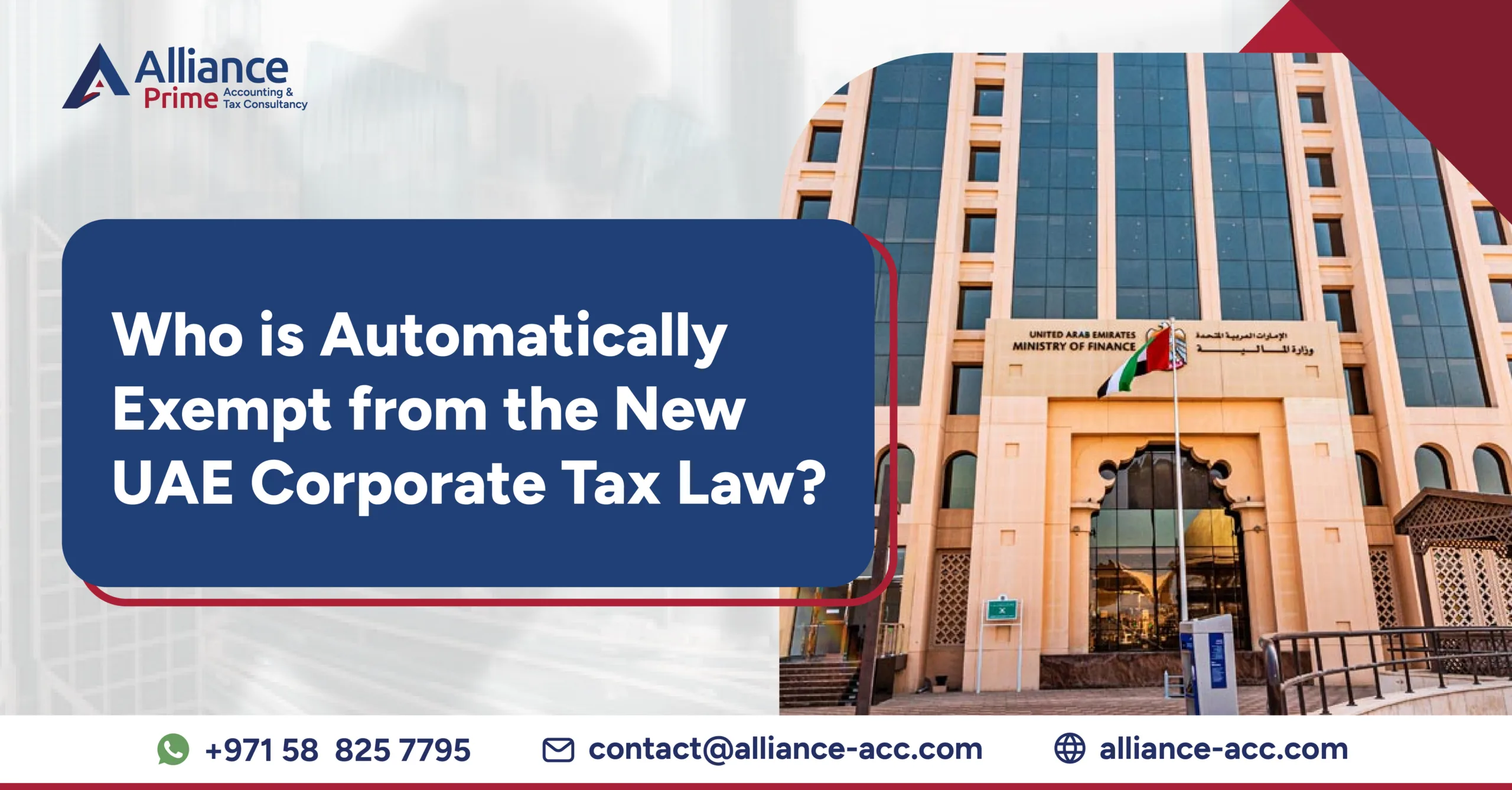
Let’s see who is Exempt from the New UAE Corporate Tax Lawy. In the ever-evolving landscape of corporate taxation, understanding the nuances of exemptions and liabilities is paramount for businesses to thrive. The UAE Corporate Tax Law encompasses provisions that outline exemptions for certain entities, relieving them from the obligation to pay corporate tax. In this article, we delve into the concept of “Exempt Persons” and shed light on the criteria that lead to automatic exemption under the UAE Corporate Tax Law.
Automatically Exempt from the New UAE Corporate Tax
Exemption from corporate tax is not a one-size-fits-all concept. Under the UAE Corporate Tax Law, specific categories of persons are deemed automatically exempt from corporate tax. The law explicitly identifies certain entities that fall under this exemption umbrella. A prime example of this is Government Entities and Government-Controlled Entities, which are automatically considered Exempt Persons under the law.
Exemption Claimed Through Application
For entities not covered by automatic exemption, the UAE Corporate Tax Law allows for the possibility of claiming exempt status through a formal application. These entities can apply for exemption from corporate tax, subject to the fulfillment of certain conditions. The Federal Tax Authority carefully examines such applications to determine eligibility and compliance.
Government and Government-Controlled Entities
Government-owned and controlled entities hold a special status in the realm of corporate tax exemption. According to Article 5 of the UAE Corporate Tax Law, all Government and Government-Controlled Entities are automatically exempt from corporate tax unless they engage in business activities beyond their ‘Mandated Activity.’ This mandate ensures that core government functions remain exempt while commercial activities are subjected to tax.
Article 5: Government Entity Working Under License
When a Government Entity conducts business under a license, it is regarded as an independent business entity. Consequently, such a Government Entity becomes liable for corporate tax, as per the provisions of the UAE Corporate Tax Law. The entity must maintain separate financial statements for its independent activities and calculate taxable income separately for each tax period. Transactions between the Government Entity and its independent business are treated as related party transactions.
Applicability of Provisions of Article 6: Government Controlled Entities
Government-Controlled Entities, as defined in Article 6 of the UAE Corporate Tax Law, are also exempt from corporate tax, provided they engage solely in Mandated Activities. Mandated Activities are those specified by the legal instrument that establishes the Government-Controlled Entity. Activities falling outside this mandate are considered independent business activities and are subject to corporate tax.
Conclusion
Navigating the intricate landscape of exemptions and liabilities under the UAE Corporate Tax Law is a crucial aspect of business operations. While Government Entities and Government-Controlled Entities enjoy automatic exemption, other entities can seek exemption through a formal application process. Understanding these nuances not only ensures compliance but also enables businesses to make informed decisions that align with their growth strategies.
Why is Alliance Prime the best Tax Consultancy in Dubai?
Alliance Prime is a leading provider of auditing, accounting, taxation, and advisory services in the UAE. Our expert team will guide you through the complex laws and regulations of UAE, including Corporate Tax, VAT, Excise Tax, Accounting and Bookkeeping, ESR, Financial Advisory, ERP, etc. We stay up-to-date with the latest changes in laws and regulations in the UAE. If you’re looking for reliable and professional auditing, accounting, taxation, and advisory services in the UAE, look no further than Alliance Prime.
To find out if your business is Exempt from the New UAE Corporate Tax or to Book a Free Consultation, contact us on: at- +971 58 825 7795 or Email us at:- contact@alliance-acc.com
Exploring Transfer Pricing Methods Under OECD Guidelines
In the intricate landscape of global business transactions, transfer pricing plays a pivotal role in determining the fair pricing of transactions between related entities. The Organisation for Economic Co-operation and Development (OECD) has formulated comprehensive guidelines to ensure that cross-border transactions are conducted at arm’s length prices, avoiding any undue advantage or disadvantage. This article delves into the transfer pricing methods as outlined by the OECD and their relevance in the realm of corporate taxation.
Traditional Transaction Methods
Under the OECD’s guidance, traditional transaction methods are employed to align controlled transactions with comparable uncontrolled transactions. These methods include:
- Comparable Uncontrolled Price Method (CUP): This method draws parallels between prices observed in controlled and uncontrolled transactions, offering a tangible reference point.
- Resale Price Method (RPM): Businesses apply this method by deducting the resale margin from the resale price, revealing an appropriate arm’s length price.
- Cost Plus Method (CPM): By adding an appropriate profit margin to the costs incurred by the seller, this method establishes pricing congruent with prevailing market norms.
Transactional Profit Methods
Transactional profit methods focus on distributing profits fairly among multiple entities involved in a transaction. They consist of:
- Transactional Profit Split Method (TPSM): Designed for transactions with multiple contributors, this method ensures a fair distribution of profits reflective of individual inputs.
- Transactional Net Margin Method (TNMM): This approach evaluates profitability by comparing net profit margins against relevant costs, offering insights into the viability of pricing structures.
Selecting the Appropriate Method
Choosing the right transfer pricing method requires a multifaceted approach. Factors such as the availability of information, the strengths and weaknesses of each method, and the appropriateness of the chosen method for the transaction’s nature must be considered. Once a suitable method and reliable comparables are identified, an arm’s length range can be calculated, providing a benchmark for pricing.
Balancing Guidelines and Business Realities
While the OECD-endorsed methods offer a solid foundation for determining transfer prices, it’s essential to note that regulatory frameworks might allow for alternative approaches. However, businesses must ensure that the chosen method is robust and well-documented, meeting the rigorous standards of transfer pricing regulations. Additionally, the method should align with the stipulated requisites under the UAE’s corporate tax law.
Conclusion
Navigating the intricate world of transfer pricing requires a comprehensive understanding of the OECD’s recommended methods and their practical applications. At Alliance Prime, we provide expert guidance on transfer pricing and corporate tax matters, helping businesses make informed decisions that align with both global guidelines and local regulations. To embark on a journey towards effective tax planning, compliance, and strategic growth, reach out to us for a free consultation:
Why is Alliance Prime the best Tax Consultancy in Dubai?
Alliance Prime is a leading provider of auditing, accounting, taxation, and advisory services in the UAE. Our expert team will guide you through the complex laws and regulations of UAE, including Corporate Tax, VAT, Excise Tax, Accounting and Bookkeeping, ESR, Financial Advisory, ERP, etc. We stay up-to-date with the latest changes in laws and regulations in the UAE. If you’re looking for reliable and professional auditing, accounting, taxation, and advisory services in the UAE, look no further than Alliance Prime.
To find out if your business is eligible for Small Business Relief under the new CT regime or to Book a Free Consultation, contact us on: at- +971 58 825 7795 or Email us at:- contact@alliance-acc.com
Administrative Penalties for Corporate Tax Violations in the UAE

In the ever-evolving landscape of corporate taxation, compliance is not merely a choice—it’s an absolute necessity. The UAE Ministry of Finance (MoF) has taken a significant stride towards fortifying corporate tax compliance with the introduction of Cabinet Decision No (75) of 2023. This decision shines a spotlight on administrative penalties for infringements related to the Federal Decree-Law No 47 of 2022—an essential development that businesses must be well-versed in.
Effective Date: August 1st
Circle August 1st on your calendar, for it heralds a pivotal juncture in the realm of corporate tax in the UAE. Cabinet Decision No (75) of 2023 delineates a comprehensive framework of administrative penalties that will be enforced by the Federal Tax Authority. These penalties are meticulously aimed at ensuring the proficient application and adherence to the corporate tax law, while also facilitating a seamless transition for businesses that embrace the new regulations.
Harmonizing Compliance and Growth
The bedrock of these administrative penalties rests on equilibrium. They have been carefully crafted to uphold corporate tax compliance without burdening businesses that align themselves with the regulations. This balanced approach stands as a testament to the UAE’s dedication to nurturing sustainable economic growth through an enabling legislative environment—one that fosters tax compliance and aligns with global standards.
Key Highlights of Administrative Penalties
These administrative penalties are applicable to taxable entities, encompassing both individuals and legal entities, who fall short of fulfilling their obligations under the UAE corporate tax law. These penalties encompass a range of violations, including:
- Failure to file and pay corporate tax on time.
- Omission to notify the Federal Tax Authority about cases necessitating amendments to tax records.
- Inadequate record-keeping or improper submission of required records and information as outlined in the tax law.
For Expert Guidance on Corporate Tax
To safeguard your business from corporate tax violations and to ensure seamless compliance with the evolving corporate tax regulations in the UAE, Alliance Prime is your steadfast partner. Our dedicated experts are here to guide you through the intricacies of corporate tax compliance.
Why is Alliance Prime the best Tax Consultancy in Dubai?
Alliance Prime is a leading provider of auditing, accounting, taxation, and advisory services in the UAE. Our expert team will guide you through the complex laws and regulations of UAE, including Corporate Tax, VAT, Excise Tax, Accounting and Bookkeeping, ESR, Financial Advisory, ERP, etc. We stay up-to-date with the latest changes in laws and regulations in the UAE. If you’re looking for reliable and professional auditing, accounting, taxation, and advisory services in the UAE, look no further than Alliance Prime.
To find out if your business is eligible for Small Business Relief under the new CT regime or to Book a Free Consultation, contact us on: at- +971 58 825 7795 or Email us at:- contact@alliance-acc.com
UAE Corporate Tax: How to Treat Tax Losses in UAE
In the dynamic landscape of business, losses are an unfortunate but often unavoidable reality. Economic downturns, market volatility, or even strategic miscalculations can lead to financial setbacks for companies, especially small businesses. The UAE Corporate Tax regime recognizes this reality and offers a lifeline to businesses in the form of the “loss carry forward” provision. This provision allows businesses to transfer tax losses in UAE to offset losses incurred in one period against future taxable income, providing a crucial opportunity for recovery and growth.
Understanding the Loss Carry Forward Provision
The UAE Corporate Tax introduces a forward-thinking approach to handling tax losses in UAE. If your business faces losses in a specific tax period, you can potentially use these losses to reduce your taxable income in subsequent tax periods. This provision aims to ensure consistent taxation irrespective of profit fluctuations, fostering economic stability and growth in the business landscape.
How Much Can You Offset?
Under the UAE Corporate Tax regime, businesses can carry forward losses and offset them against future taxable income. This offset is limited to a maximum of 75% of the taxable income in each of those future periods. This means that even if all accumulated losses are not fully offset, businesses are required to pay taxes on at least 25% of their taxable income. Determining the exact amount of tax losses you can carry forward can be a complex task, best undertaken with the guidance of experienced corporate tax consultants in Dubai.
The Time Frame: How Long Can You Carry Forward Tax Losses in UAE?
The flexibility of the UAE Corporate Tax regime becomes evident when considering the time frame for carrying forward losses. As per the UAE Corporate Tax Public Consultation Document, businesses can carry forward losses indefinitely. This perpetual provision offers businesses the opportunity to strategically manage their financial position over the long term.
Conditions for Indefinite Loss Carry Forward
While the prospect of indefinite loss carry forward is promising, certain conditions must be met to avail of this benefit. Corporate tax consultants in Dubai play a crucial role in helping businesses navigate these conditions. The main conditions include:
- Continuity of Ownership Requirement: If the same shareholder or shareholders maintain at least 50% of the share capital from the inception of the loss-incurred period to the period of loss offset against taxable income, the losses can be carried forward indefinitely. Expert corporate tax advisors can assess if your business fulfills this continuity of ownership test.
- Continuity of Business Requirements: Even if the continuity of ownership test isn’t met, businesses can still carry forward losses if they meet the continuity of business test. This implies that if a business undergoes a change in ownership of more than 50%, it can still carry forward tax losses in UAE if the new owners continue the same business operations.
- Special Conditions for Listed Companies: Listed companies on recognized stock exchanges have their unique considerations. The continuity of business or ownership tests may not be applicable to them. These businesses must await the final issuance of the UAE Corporate Tax Law to determine their eligibility for loss carry forward.
Exclusions: Tax Losses in UAE that Cannot be Carried Forward
While the loss carry forward provision is a valuable tool for businesses, certain types of losses are excluded from this benefit:
- Losses incurred before the effective date of UAE corporate tax (June 1st, 2023).
- Losses incurred before becoming a taxpayer for corporate tax purposes.
- Losses arising from activities or assets generating income exempt from corporate tax.
- Losses from activities or assets generating income exempt from UAE Corporate Tax.
- Losses incurred by a Free Zone Person that cannot be attributed to a Permanent Establishment (PE) in the mainland.
Expert Guidance for Successful Tax Planning
Navigating the intricate realm of corporate taxation, especially concerning loss carry forward, requires expert guidance. Alliance Prime, a trusted name in accounting and tax consultancy based in Dubai, is your partner in understanding and leveraging the UAE Corporate Tax provisions. With a team of experienced corporate tax consultants, Alliance Prime offers bespoke services tailored to your business’s unique needs. From corporate tax registration to return filing, financial statement auditing, and comprehensive tax planning, Alliance Prime has you covered.
Prepare for the future with confidence. Consult with Alliance Prime’s corporate tax advisors in Dubai today and embark on a journey of informed tax planning, financial stability, and sustainable growth. Contact us now to ensure your business thrives in the evolving landscape of corporate taxation.
Disclaimer: The information provided in this article is based on the UAE Corporate Tax regime and relevant sources available up to the knowledge cutoff date of September 2021. It’s important to note that tax laws and regulations are subject to change, and businesses should stay updated with the latest developments. Alliance Prime recommends consulting with their expert corporate tax consultants for the most accurate and current guidance.
Why is Alliance Prime the best Tax Consultancy in Dubai?
Alliance Prime is a leading provider of auditing, accounting, taxation, and advisory services in the UAE. Our expert team will guide you through the complex laws and regulations of UAE, including Corporate Tax, VAT, Excise Tax, Accounting and Bookkeeping, ESR, Financial Advisory, ERP, etc. We stay up-to-date with the latest changes in laws and regulations in the UAE. If you’re looking for reliable and professional auditing, accounting, taxation, and advisory services in the UAE, look no further than Alliance Prime.
To find out if your business is eligible for Small Business Relief under the new CT regime or to Book a Free Consultation, contact us on: at- +971 58 825 7795 or Email us at:- contact@alliance-acc.com
Leveraging Tax Loss Relief in UAE: Navigating Corporate Benefits
In the intricate world of business finance, occasional setbacks are inevitable. When your expenses surpass your revenue, resulting in a negative Taxable Income, it might seem like a financial conundrum. However, this situation, known as “Tax Loss,” can be transformed into a powerful tool for strategic maneuvering. Enter Article 37 of the UAE’s Corporate Tax Law, a beacon of relief that empowers businesses to leverage Tax Losses for future benefits. In this article, we delve into the nuances of Tax Loss Relief in UAE and its strategic utilization, with a spotlight on Alliance Prime Accounting and Tax Consultancy—a trusted partner in navigating UAE’s tax complexities.
Tax Loss Relief in UAE under Article 37:
Article 37 of the UAE’s Corporate Tax Law provides a unique opportunity for businesses to turn Tax Losses into strategic assets. A Tax Loss incurred in one Tax Period can be offset against the Taxable Income of subsequent periods. This offsetting mechanism acts as a shield, effectively reducing your Taxable Income and, consequently, your tax liability. This relief not only eases financial burdens but also encourages businesses to plan for sustainable growth.
The 75% Threshold:
While Tax Loss Relief is a blessing, there’s a reasonable limit to its utilization. According to the law, the amount of Tax Loss that can be adjusted should not exceed seventy-five percent (75%) of the Taxable Income for any given Tax Period. This provision ensures a balanced approach, allowing businesses to reap the benefits of Tax Loss Relief without overextending the offsetting process.
Strategic Utilization and Business Impact:
Tax Loss carried forward isn’t a dormant asset—it’s a valuable resource waiting to be tapped into. Strategic utilization involves setting off the Tax Loss against subsequent Taxable Income, creating a ripple effect that enhances financial efficiency. This utilization not only reduces the immediate tax liability but also paves the way for sustained growth and improved profitability. Only after this strategic utilization can any remaining Tax Loss be carried forward or potentially transferred to another eligible entity.
Alliance Prime Accounting and Tax Consultancy: Your Strategic Partner
Effectively navigating the intricacies of Tax Loss Relief in UAE demands expertise and finesse. Alliance Prime Accounting and Tax Consultancy stands as your dedicated partner in unraveling these complexities. With a team of seasoned experts, the consultancy ensures that your Tax Losses are strategically leveraged, minimizing tax liability while adhering to legal frameworks. Their commitment to compliance and financial advisory empowers businesses to make informed decisions that drive growth and success.
Conclusion:
Tax Loss Relief in UAE, as provided by Article 37 of the UAE’s Corporate Tax Law, presents a unique opportunity for businesses to transform setbacks into strategic advantages. By strategically utilizing Tax Losses, businesses can not only reduce their immediate tax liability but also pave the way for sustainable growth and improved profitability. Alliance Prime Accounting and Tax Consultancy offers expert guidance, ensuring businesses maximize the benefits of Tax Loss Relief while staying compliant with evolving tax regulations in the UAE. To embark on a journey towards financial efficiency and growth, contact Alliance Prime Accounting and Tax Consultancy today.
Why is Alliance Prime the best Tax Consultancy in Dubai?
Alliance Prime is a leading provider of auditing, accounting, taxation, and advisory services in the UAE. Our expert team will guide you through the complex laws and regulations of UAE, including Corporate Tax, VAT, Excise Tax, Accounting and Bookkeeping, ESR, Financial Advisory, ERP, etc. We stay up-to-date with the latest changes in laws and regulations in the UAE. If you’re looking for reliable and professional auditing, accounting, taxation, and advisory services in the UAE, look no further than Alliance Prime.
To find out if your business is eligible for Small Business Relief under the new CT regime or to Book a Free Consultation, contact us on: at- +971 58 825 7795 or Email us at:- contact@alliance-acc.com
What is Transfer Pricing in UAE Corporate Tax Law?
In the intricate realm of international business, Transfer Pricing takes center stage. It’s not just about pricing; it’s about fairness, compliance, and aligning with global standards. Let’s delve into the essence of Transfer Pricing in UAE Corporate Tax Law.
Understanding Transfer Pricing in UAE
Imagine a subsidiary company selling goods or services to its holding company. The price charged—the Transfer Price—is pivotal. It reflects the arm’s length value, simulating a transaction between independent entities. Multinational corporations employ Transfer Pricing to distribute profits across branches, but regulatory authorities frown upon tax manipulation.
Applicability of Transfer Pricing in UAE
To eliminate biases in international transactions, UAE Corporate Tax Law steps in. It governs dealings between Related Parties and Connected Persons. These Transfer Pricing Rules, harmonized with OECD standards, ensure a level playing field.
Embracing the Arm’s Length Principle
The cornerstone of UAE’s transfer pricing regime is the Arm’s Length Principle. Rooted in OECD Transfer Pricing Guidelines, this principle dictates that related party transactions must reflect market norms. Specific methods, internationally recognized, determine this fairness. Businesses can opt for alternative methods if warranted, under expert guidance.
A Path Forward
As the UAE Corporate Tax Law sets its course from June 1, 2023, clarity in Transfer Pricing becomes indispensable. Trust in the expertise of Alliance Prime to guide you through, ensuring compliance, avoiding penalties, and charting a course for success in the global business arena. Connect with us for unwavering tax solutions tailored to your needs.
Expert Guidance on Transfer Pricing and Compliance
Whether you’re navigating the complexities of Transfer Pricing or aiming to ensure compliance with evolving CT regulations in the UAE, Alliance Prime is here to assist you. Our dedicated team offers expert guidance and tailored solutions for your business needs.
Why is Alliance Prime the best Tax Consultancy in Dubai?
Alliance Prime is a leading provider of auditing, accounting, taxation, and advisory services in the UAE. Our expert team will guide you through the complex laws and regulations of UAE, including Corporate Tax, VAT, Excise Tax, Accounting and Bookkeeping, ESR, Financial Advisory, ERP, etc. We stay up-to-date with the latest changes in laws and regulations in the UAE. If you’re looking for reliable and professional auditing, accounting, taxation, and advisory services in the UAE, look no further than Alliance Prime.
To find out if your business is eligible for Small Business Relief under the new CT regime or to Book a Free Consultation, contact us on: at- +971 58 825 7795 or Email us at:- contact@alliance-acc.com