

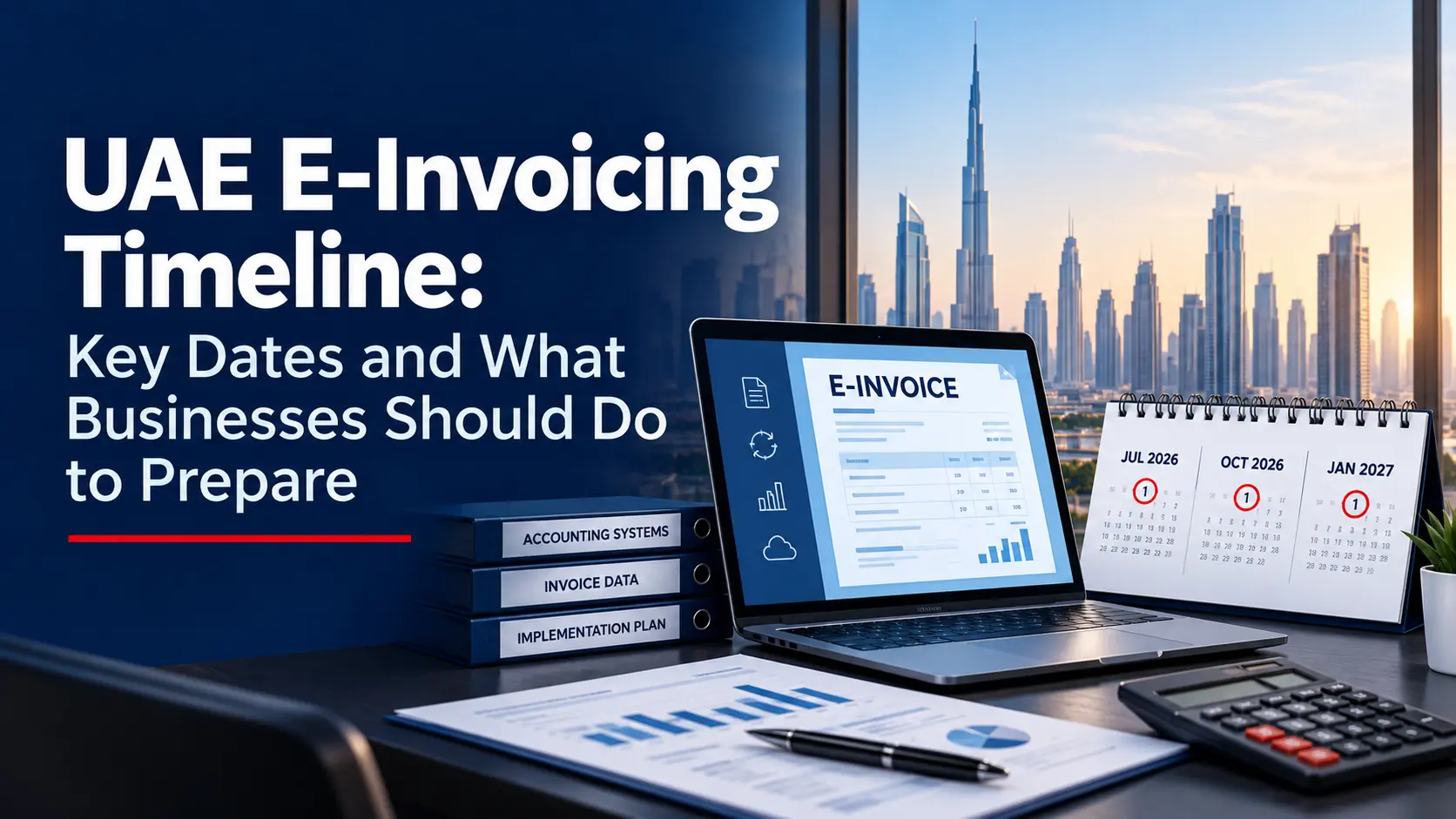
E-invoicing is set to transform the way businesses in the UAE create, exchange, process, and manage invoices.
For many businesses, the transition will involve much more than replacing paper invoices with digital documents. Companies may need to review their accounting systems, invoice data, internal processes, and technology infrastructure to prepare for a more structured electronic invoicing environment.
As the UAE moves forward with its e-invoicing programme, early preparation can help businesses manage the transition more efficiently and reduce last-minute implementation challenges.
This guide explains the UAE e-invoicing timeline, what the change means for businesses, and the practical steps companies can start taking now.
What Is E-Invoicing in the UAE?
E-invoicing is the electronic creation and exchange of invoice information in a structured, machine-readable format.
This distinction is important.
A traditional invoice created as a PDF and emailed to a customer may be digital, but that does not necessarily make it an e-invoice. A structured e-invoice allows invoice information to be exchanged and processed electronically between compatible systems.
The UAE’s approach to e-invoicing is therefore expected to change not only how invoices are sent but also how invoice data moves between businesses and relevant parties.
Why Is the UAE Introducing E-Invoicing?
The transition towards e-invoicing is part of the UAE’s wider digital transformation of financial and tax administration.
A structured electronic invoicing environment can support greater automation and standardisation in business transactions.
For businesses, this may also create opportunities to reduce manual invoice processing, improve data accuracy, strengthen financial record keeping, and make invoice reconciliation more efficient.
However, achieving these benefits requires businesses to prepare their systems and processes before the relevant implementation requirements apply to them.
UAE E-Invoicing Timeline: Important Stages to Watch
The UAE is moving towards e-invoicing through a phased implementation rather than requiring every business to transition at the same time.
1 July 2026 – Voluntary Implementation
The voluntary implementation phase begins from 1 July 2026.
This gives businesses an opportunity to begin adopting the e-invoicing framework ahead of mandatory implementation.
For companies that are ready, early adoption can provide valuable time to test systems, identify data issues, train employees, and address integration challenges before e-invoicing becomes mandatory for them.
October 2026 – An Important Preparation Milestone
For businesses entering the first mandatory implementation phase, October 2026 represents an important milestone in the transition process.
Companies should therefore avoid treating the mandatory go-live date as the starting point for preparation.
System assessments, service-provider considerations, invoice-data reviews and implementation planning may need to happen considerably earlier.
1 January 2027 – Mandatory Implementation Begins for the First Phase
The first mandatory implementation phase is scheduled to begin from 1 January 2027, including businesses falling within the applicable revenue threshold for that phase.
For businesses with annual revenue of AED 50 million or more, this makes 2026 a critical preparation period.
Businesses should confirm the requirements that apply to their specific circumstances rather than assuming that their existing invoicing software will automatically meet the new framework.
Why Businesses Should Start Preparing Before Their Deadline
E-invoicing implementation is not simply a finance department task.
It can involve multiple areas of an organisation, including:
- Finance and accounting
- Tax
- Information technology
- Procurement
- Sales
- Accounts payable and receivable
- ERP and accounting-system administrators
Waiting until shortly before the applicable implementation date could create unnecessary pressure across these teams.
Businesses should instead treat e-invoicing as a structured transformation project with clear responsibilities, timelines, testing and implementation stages.
What Should UAE Businesses Do to Prepare for E-Invoicing?
1. Determine When the Requirements Apply to Your Business
The first step is understanding where your organisation falls within the UAE e-invoicing implementation timeline.
Businesses should review their revenue, legal structure, transaction profile and other relevant criteria to determine which implementation phase applies.
For groups with multiple entities, the assessment may require additional attention.
2. Review Your Current Invoicing Process
Businesses should map how invoices are currently created, approved, sent, received and stored.
Questions to consider include:
- How are sales invoices currently generated?
- Are invoices created manually or through an ERP/accounting system?
- How are supplier invoices received?
- What invoice information is currently captured?
- Are there manual steps that could create data-quality issues?
- How are invoice records stored and retrieved?
Understanding the current process makes it easier to identify what needs to change.
3. Check Whether Your Accounting or ERP System Is Ready
One of the most important areas to assess is your existing technology.
Businesses using accounting software or enterprise resource planning systems should determine whether their current solution can support the required e-invoicing processes.
Do not assume that because your software can generate electronic or PDF invoices, it is automatically ready for structured e-invoicing.
Speak with your software vendor or technology team early to understand what upgrades, integrations or configuration changes may be required.
4. Understand the Role of Peppol
Peppol is an important concept for businesses preparing for UAE e-invoicing.
Rather than businesses simply emailing invoices directly to one another, structured invoice information can be exchanged electronically through an interoperable network and connected service providers.
For businesses, this means e-invoicing readiness may involve ensuring that internal accounting or ERP systems can communicate effectively with the wider e-invoicing ecosystem.
Understanding this architecture early can make technical planning significantly easier.
5. Prepare for the Role of Accredited Service Providers
Service providers are expected to play an important role in facilitating the exchange of e-invoices within the UAE framework.
Businesses should therefore understand:
- What services will be required
- How a provider will connect with their existing systems
- What data will need to be exchanged
- How invoice validation and transmission will work
- What implementation and testing support may be required
Provider selection should not be treated as a last-minute decision.
6. Review the Quality of Your Invoice Data
Technology alone cannot solve poor-quality financial data.
Businesses should review whether the information contained within their existing invoices is accurate, complete and consistently recorded.
This could include customer and supplier details, tax information, transaction descriptions, invoice references and other required data fields.
A structured electronic environment makes data quality particularly important because information is intended to be processed electronically rather than interpreted manually from an invoice document.
7. Bring Finance, Tax and IT Teams Together
A common mistake would be treating e-invoicing as solely an accounting project or solely an IT project.
Successful implementation is likely to require collaboration between both.
The finance and tax teams understand the transactions and compliance requirements, while IT teams understand system architecture, integrations, data mapping and technical limitations.
Businesses should establish clear ownership of the project and involve all relevant stakeholders early.
8. Test Before Going Live
Businesses should leave sufficient time for testing before their mandatory implementation date.
Testing can help identify issues involving:
- Invoice formats
- Missing or incorrect data
- ERP integrations
- Customer and supplier information
- System connectivity
- Internal approval workflows
- Invoice transmission and receipt
Identifying these problems during testing is much easier than discovering them after mandatory implementation begins.
PDF Invoices and E-Invoices Are Not the Same
One misconception businesses should address early is that sending an invoice electronically automatically means they are already e-invoicing.
For example, creating a PDF invoice and emailing it to a customer is an electronic method of delivering a document.
However, structured e-invoicing is fundamentally different because invoice data is generated and exchanged in a machine-readable format that allows systems to process the information electronically.
Businesses currently relying on PDF invoices should therefore not assume that no changes will be required.
How E-Invoicing Could Affect Accounting and Bookkeeping
E-invoicing is also likely to influence day-to-day accounting and bookkeeping operations.
Structured invoice data can reduce dependence on manual data entry and may improve the efficiency of accounts payable and accounts receivable processes.
For accounting teams, the transition may affect:
Invoice processing: More transaction information can move directly between systems.
Reconciliation: Structured information may make it easier to match invoices with accounting records.
Record keeping: Businesses will need processes capable of maintaining accurate and accessible transaction information.
VAT processes: Invoice information and tax treatment will need to remain accurate within the new digital workflow.
Internal controls: Businesses may need to update approval processes and responsibilities as invoice workflows become increasingly automated.
This is why businesses should look at e-invoicing as part of their wider accounting, tax and digital transformation strategy, rather than as a standalone software change.
Common E-Invoicing Preparation Mistakes to Avoid
As implementation approaches, businesses should avoid several common mistakes.
One is waiting until the mandatory date is close before assessing system readiness.
Another is assuming existing accounting software will automatically satisfy all e-invoicing requirements.
Businesses should also avoid overlooking invoice-data quality, leaving IT teams out of the planning process, or failing to test new workflows before implementation.
Early preparation provides more time to address these issues without disrupting normal business operations.
UAE E-Invoicing Readiness Checklist
Before your applicable implementation deadline, consider whether your business has:
✓ Identified the implementation phase that applies to it
✓ Reviewed existing invoice workflows
✓ Assessed accounting and ERP system readiness
✓ Understood the structured e-invoicing model
✓ Evaluated service-provider requirements
✓ Reviewed customer and supplier master data
✓ Checked the quality of invoice information
✓ Involved finance, tax and IT teams
✓ Planned system integration and testing
✓ Developed an internal implementation timeline
If several of these areas have not yet been addressed, now is a good time to begin.
Start Preparing for UAE E-Invoicing Early
E-invoicing represents a significant change in the way businesses manage financial transactions in the UAE.
While mandatory implementation will be phased, businesses should not wait until their individual deadline to start preparing.
Reviewing your systems, invoice data, internal processes and technology requirements in advance can make the transition more manageable and help your organisation build a stronger digital invoicing process.
How Alliance Prime Can Help
Alliance Prime Accounting & Tax Consultancy can assist businesses in understanding UAE e-invoicing requirements and evaluating their current accounting and invoicing processes.
From accounting and bookkeeping support to VAT compliance and e-invoicing readiness, businesses can take practical steps now to prepare for the UAE’s evolving digital tax environment.
Is your business ready for UAE e-invoicing? Talk to our experts today and start preparing ahead of the applicable deadline.