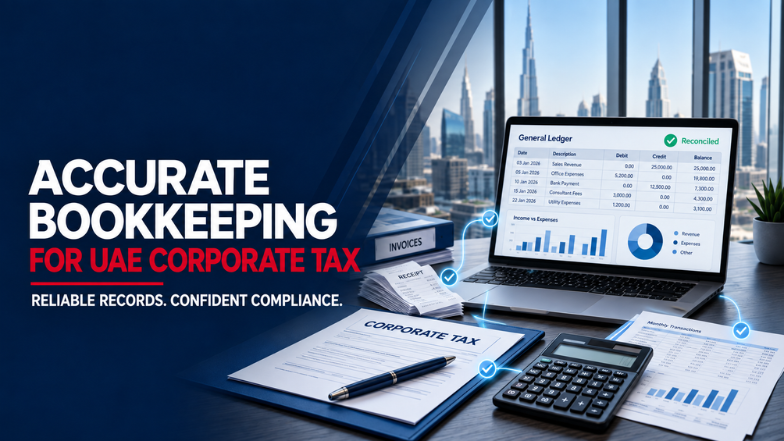
Accurate bookkeeping is one of the foundations of UAE Corporate Tax compliance. A Corporate Tax return is not prepared in isolation: it depends on the business’s financial records, accounting classifications, reconciliations and supporting documents.
When bookkeeping is complete and current, a business can calculate its taxable income more reliably, identify adjustments more efficiently and support the figures reported in its tax return. When records are incomplete or inconsistent, even routine tax work can become slower, more expensive and more exposed to error.
This article explains why bookkeeping matters for UAE Corporate Tax and what businesses can do to strengthen their records before the filing period begins.
Bookkeeping Connects Daily Transactions to the Tax Return
Bookkeeping records the financial events that take place throughout the year, including sales, purchases, expenses, receipts, payments, payroll entries, asset acquisitions and financing transactions. These entries ultimately feed into the financial statements used as the starting point for Corporate Tax calculations.
Corporate Tax is not simply calculated from the balance in a bank account or the total shown on sales invoices. The accounting result must first be established, after which the relevant tax treatment and adjustments can be considered. If the underlying entries are inaccurate, the tax calculation may also be inaccurate.
Good bookkeeping therefore creates a traceable connection between each business transaction, the accounting ledger, the financial statements and the Corporate Tax return.
How Accurate Bookkeeping Supports UAE Corporate Tax
1. It helps determine revenue and expenses correctly
A reliable tax calculation requires revenue and expenses to be recorded in the correct period and under appropriate accounts. Missing sales, duplicated costs or incorrectly dated transactions can distort accounting profit and affect the amount considered for tax purposes.
Regular transaction posting and month-end reviews make it easier to detect these issues before year-end.
2. It separates business and non-business transactions
Personal payments, shareholder transactions and expenses that are not connected with the business should not be mixed casually with ordinary operating costs. Clear classifications allow the accountant or tax professional to review the nature of an amount and assess the appropriate treatment.
Using dedicated business bank accounts, clear approval processes and descriptive ledger entries can significantly improve this separation.
3. It supports the review of deductible expenses
Recording an expense does not automatically determine its Corporate Tax treatment. The purpose, supporting evidence and applicable tax rules must still be considered. Accurate bookkeeping makes that review possible by preserving information about what was purchased, why it was incurred and how it relates to the business.
Generic descriptions such as ‘miscellaneous expense’ make tax review difficult. Specific account names and complete documents provide much better support.
4. It creates a clear audit trail
An audit trail connects the amount in the ledger to its source evidence. Depending on the transaction, this may include an invoice, contract, purchase order, receipt, bank entry, credit note or payment confirmation.
A clear audit trail helps a business explain how a reported figure was calculated and respond more efficiently if information is requested. It also allows management and advisers to review unusual or material transactions without rebuilding the history from incomplete emails and files.
5. It improves the accuracy of year-end adjustments
Corporate Tax work often depends on accounting adjustments made at the end of a reporting period. These may relate to accruals, prepayments, depreciation, provisions, inventory, foreign currency balances or transactions between related parties.
Current ledgers and completed reconciliations give the accountant a dependable base for identifying and recording these adjustments. If basic bookkeeping is unfinished, there is a greater risk that year-end entries will be missed or based on incomplete information.
6. It helps businesses meet filing deadlines
Corporate Tax preparation becomes more manageable when records are maintained throughout the year. Waiting until the filing deadline approaches can reveal missing documents, unreconciled accounts and unexplained balances at the worst possible time.
A monthly bookkeeping and review schedule spreads the workload across the year and gives the business time to resolve questions before the return is due.
7. It supports the required retention of records
Under the UAE Corporate Tax framework, taxable persons must keep records and documents that support the information provided in a Corporate Tax return and allow taxable income to be readily determined. Corporate Tax records are generally required to be retained for seven years following the end of the relevant tax period.
A consistent filing system is therefore as important as recording the accounting entry. Businesses should be able to retrieve the supporting evidence later, even if staff members or software systems change.
Common Bookkeeping Problems That Can Affect Corporate Tax
Several recurring bookkeeping problems can weaken the reliability of a Corporate Tax calculation:
- sales or expenses recorded in the wrong accounting period
- bank and credit-card accounts that have not been reconciled
- duplicate invoices or payments
- missing supplier invoices and expense evidence
- personal and business expenditure recorded together
- vague or inconsistent account classifications
- asset purchases recorded entirely as routine expenses
- balances carried forward without review
- transactions with owners or related parties recorded without sufficient detail
Not every bookkeeping error will produce the same tax outcome. However, each unresolved issue increases the time and judgement required to prepare a reliable return.
A Practical Example
Consider a UAE company that pays several annual software subscriptions in advance. If the full payments are posted as expenses immediately without reviewing the period they cover, the financial statements may not reflect the expense in the appropriate period.
The accountant must first identify the transactions, examine the supporting invoices and make the appropriate accounting adjustment. That accounting result can then be reviewed for Corporate Tax purposes. With timely bookkeeping and monthly reconciliations, the issue can be identified early rather than during last-minute return preparation.
A Practical Bookkeeping Checklist for UAE Businesses
To improve Corporate Tax readiness, businesses should consider the following routine:
- record transactions promptly and consistently
- reconcile bank, card and payment-gateway accounts regularly
- maintain separate business and personal finances
- retain invoices, contracts, receipts and payment evidence
- use a clear and consistent chart of accounts
- review receivables, payables, loans and owner balances
- maintain an up-to-date fixed asset register
- complete periodic inventory checks where relevant
- document unusual and related-party transactions
- review the trial balance and financial reports each month
- maintain secure backups and controlled access to records
- address unexplained balances before the financial year ends
The exact process should reflect the size, activities and complexity of the business.
Why Year-End Bookkeeping Alone Is Not Enough
Treating bookkeeping as an annual exercise may appear economical, but it often shifts cost and pressure to the filing period. Historical errors are harder to investigate, missing documents may be difficult to recover and management loses access to current financial information during the year.
Monthly bookkeeping provides a more reliable alternative. It enables regular reconciliations, faster corrections and better visibility over cash flow, profitability and outstanding balances. Corporate Tax compliance then becomes part of an established financial process rather than an emergency project.
How Alliance Prime Can Help
Alliance Prime Accounting and Tax Consultancy supports UAE businesses with accounting, bookkeeping and Corporate Tax services. Our professionals can help maintain transaction records, perform reconciliations, review ledgers, prepare financial reports and organise the information needed for tax compliance.
By connecting day-to-day bookkeeping with year-end accounting and Corporate Tax requirements, we help businesses improve the quality of their records and approach filing with greater clarity.
Need support with your accounting records or Corporate Tax preparation? Book your free consultation with Alliance Prime today.
Frequently Asked Questions
Is bookkeeping mandatory for UAE Corporate Tax?
Businesses must maintain records and documents that support the information in their Corporate Tax returns and enable taxable income to be determined. An appropriate bookkeeping system is the practical foundation for meeting this responsibility.
How long should UAE Corporate Tax records be kept?
Corporate Tax records and supporting documents are generally required to be retained for seven years following the end of the relevant tax period. Other laws or business circumstances may create additional retention requirements.
Can a business prepare Corporate Tax from bank statements alone?
Bank statements are useful evidence, but they normally do not provide enough information on their own. A business also needs properly classified accounting records and supporting documents such as invoices, contracts and transaction details.
How often should bookkeeping be updated?
The frequency depends on the business, but regular weekly or monthly processing is usually more reliable than waiting until year-end. High-volume businesses may need daily updates and more frequent reconciliations.
Does accounting software guarantee Corporate Tax compliance?
No. Software can automate processing and reporting, but correct setup, accurate data, reconciliations, supporting documents and professional judgement remain essential.
Conclusion
Accurate bookkeeping matters for UAE Corporate Tax because it supports every stage of the compliance process, from establishing the accounting result to reviewing adjustments, filing the return and answering future questions about reported figures.
Businesses that maintain current ledgers, reconciled balances and accessible supporting documents are better positioned to prepare reliable returns and avoid last-minute disruption. Strong Corporate Tax compliance begins long before the filing deadline; it begins with the way each transaction is recorded.
Disclaimer: This article is for general informational purposes only and does not constitute accounting, tax or legal advice. The appropriate treatment depends on the facts and applicable rules. Businesses should obtain professional advice for their circumstances and consult the latest official guidance.